Review ‘Selma’ From The Editor
Now in 2015, we live in a world of infinite information where we can find out specific and factual details, primary source documentation, and true accounts on just about any historical event, especially those in the last century during the era of widespread print journalism, radio, and television. Thanks to modern technology then and now, we can hear real historical figures and see them with our own eyes because the generations of their time documented them for lasting effect.
To say Ava DuVernay’s “Selma” feels relevant is a mammoth understatement. It’s altogether animated, propelled and enlivened by its contemporary urgency. “Selma” is a history lesson that throbs with today.
DuVernay, a former publicist with two low-budget dramas to her name, dramatizes the events around the 1965 Civil Rights march through Alabama, from Selma to Montgomery, with a straightness of purpose befitting the famous protest’s direct path.
Hollywood often doesn’t nail this kind of historical drama, and such films frequently sag under the weight of their intentions. But DuVernay, working from a script by Paul Webb, stays away from the Martin Luther King Jr. biopic this might have been. Eluding myth-making, she instead goes for a focused realism. “Selma” captures a movement, from the grassroots to the White House, and the many it takes to move history.
Even though we are lucky to live in that world of infinite information, one victim and target for that is the movie industry, where they are not so lucky. In a way, since so many people can research and see the saved and preserved actual events, films based on popular historical people and stories of the last century have a hard time being genuine or living up to the real history.
More and more, people see through the dramatization, the look of actors different from the real people they are portraying, and the shortcuts being taken by films to massage, soften, slant, skew, amplify, boost, or show bias in the interpretation of a historical person or event
Early in the film, King’s Southern Christian Leadership Conference tries to check into a Selma hotel, and a white man extends his hand only to clock King in the jaw. “This place,” says one of King’s cohorts, “is perfect.”
This is the Deep South after 1964’s landmark Civil Rights Act, but when poll taxes, vouchers and the like kept black people away from the ballot box. In an early scene, an elderly hospice nurse named Annie Lee Cooper (Oprah Winfrey) tries to register to vote, only be to be warned of “startin’ a fuss.” She’s told to name Alabama’s 67 judges.
King’s group arrives in Selma having just waged an unsuccessful campaign in Albany, Georgia, where the police avoided the kind of confrontations that would draw headlines. The toxic discrimination of Selma, though, offers King the “drama” he requires to elevate the cause to front pages. Selma Sheriff Jim Clark (Stan Houston) and Alabama Governor George Wallace (an excellent Tim Roth) supply the racist brutality that plays right into King’s mission.
A central theater of “Selma” isn’t just the Edmund Pettus Bridge, where marchers were brutally beaten by baton-wielding police — it’s in the White House. King’s strategy is trying to pressure President Lyndon Johnson into acting on voting restrictions. LBJ, played with appropriate Texan cajoling by Tom Wilkinson, wants to focus on poverty with his Great Society. (White House tapes suggest a more collaborative LBJ than shown in the film.)
Beyond the important history on display, “Selma” dives deep into the man behind the leadership. The film shows us Martin Luther King, Jr., the man and the husband behind the speeches and sermons. British actors David Oyelowo and Carmen Ejogo wear the burdensome pressure, emotions, dignity, and strength of Martin and his wife Corretta masterfully and beautifully. We are privy to their challenges more than their luster as a power couple that everyone looked up to. Their motivations and fears are fully on display and matched with a strong dedication and inspiring resolve. Both actors are triumphantly deserving of the Oscar attention for which they are being highlighted.
King is seen both intimately with his wife Coretta (Carmen Ejogo) and publicly from the pulpit, where Oyelow’s King is fullest. He’s not a savior, but a wise man exercising the reaches of his power to the best of his ability. As spectacular as Oyelow’s humanizing performance is, “Selma” is not the MLK show. King is more a savvy operator, gathering together the strong forces around him.
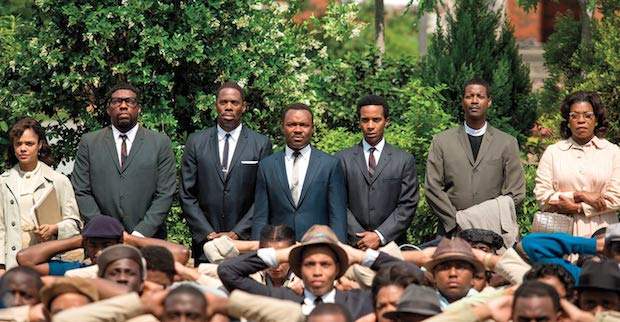
Like few movies, “Selma” is peopled, teaming with the individuals that comprise a mass. By the time the protestors have assembled on the bridge for the 50 mile march, DuVernay has put us among them, from the future Congressman John Lewis (Stephan James) to the Reverend Hosea Williams (the impeccable Wendell Pierce, whose anxious eyes look at the amassed troopers with an unforgettable mix of fear and bravery).
The recreations of the violence and the confrontations are jarring and difficult to watch, even through the PG-13 filter. Few punches are pulled, yet the tone is gentle and inspiring without overcooked theatrics. On the technical side, give credit to cinematographer Bradford Young and jazz pianist Jason Moran for making that happen with an artful reliance on lamplight, natural themes, and a minimally invasive musical score.
There’s a stirring freshness to the cinema of “Selma,” and it’s not just because of Bradford Young’s rich, moody photography. The 1978 TV miniseries “King” is the only real attempt to grapple with MLK. There are shamefully few precedents of civil rights tales in Hollywood to “Selma.” A change is gonna come.

 Sparx Entertainment